


The cybersecurity field has long been a dynamic one, but by 2026 it has achieved an infusion of pace that not even the fast could predict. It’s not about simple malware or phishing attempts as we may suppose when thinking of cyberattacks. The attackers use Artificial Intelligence (AI) for their Ransomware tools, deepfakes realistic and otherwise and large-scale phishing campaigns automation. In return, Cybersecurity Startups transforms itself and these very evolutions are spearheaded by startups.
New at large and smart at hand are solutions for 2026. Startups use AI not just in the form of some simple appetizer feature but as the main heart driving their applications. This has brought forth new ideas on how to look for threats, respond to incidents, protect from deepfakes, and even make a move toward autonomous threat hunting. Government, enterprise, or even the smallest business that wishes to remain safe while going digital must ensure cybersecurity through AI—not as a choice but as an imperative.
Key Startups Leading the Charge in AI Cybersecurity
The landscape of cyber defense is rapidly shifting from reactive monitoring to autonomous, agentic action—AIs capable of independent decision-making and proactive threat neutralization. Here are three pioneering companies leading this transformation in 2026.
ReliaQuest – Global AI-Powered Cybersecurity Leader
- Core Innovation: GreyMatter Platform – An enterprise-ready defense tool utilizing advanced machine learning models for real-time anomaly detection, rapid incident investigation, and automated response orchestration.
- 2026 Funding Milestone: Secured $500+ million at a $3.4 billion valuation, fueling their global expansion into European and Asian markets.
Traditional Manual Analysis (Hours) ➔ ➔ ➔ GreyMatter Automated Response (Seconds)
The Impact: ReliaQuest enables major corporations to secure sprawling cloud environments, hybrid workspaces, and extensive IoT (Internet of Things) infrastructures. Instead of cleaning up after a breach, its predictive AI anticipates where vulnerabilities lie, allowing teams to neutralize threats before hackers can exploit them.
🇮🇳 Safe Security – Bengaluru-Based CyberAGI Creator
- Core Innovation: CyberAGI & Continuous Threat Exposure Management (CTEM) – The world’s first agentic AI-powered CTEM platform. It functions as an independent, continuously learning framework that shifts the paradigm from passive risk-scoring to automated, real-time patch management.
- 2026 Funding Milestone: Raised $70 million, solidifying India’s reputation as a premier hub for cutting-edge cybersecurity research and development.
| Target Market | Core Vulnerability | CyberAGI Solution |
| Mid-sized Enterprises & Financial Institutions | Lack large, expensive, in-house security teams. | Provides an always-on, autonomous AI cyber analyst that continuously secures assets. |
Nebulock – Autonomous Threat-Hunting Groundbreaker
- Core Innovation: Behavioral Threat-Hunting – Moving past traditional endpoint protection and static malware signatures, Nebulock analyzes real-time behavior across servers, cloud services, and employee devices to isolate hidden risks.
- 2026 Funding Milestone: Emerged from stealth with an $8.5 million seed round (including $6 million led by Bain Capital Ventures).
Why Behavioral Hunting Matters: Modern cyberattacks are frequently “low and slow”—executed in tiny, calculated steps to slip past legacy firewalls. For example, if an attacker attempts to exfiltrate data by leaking small, fragmented batches over a long period, Nebulock’s AI immediately identifies the pattern and halts the breach in mid-execution.
2026 Funding & Market Focus Comparison
| Startup | 2026 Funding | Core Technical Focus | Primary Target Market |
| ReliaQuest | $500M+ ($3.4B Valuation) | Automated response, Multi-cloud/IoT | Global enterprise, Europe & Asia |
| Safe Security | $70M | Agentic CTEM, Auto-patching | Mid-market, Financial, Emerging markets |
| Nebulock | $8.5M (Seed) | “Low & Slow” Behavioral Threat-Hunting | Network-wide Enterprise def |
Also Read – Difference Between Network Security, Cybersecurity, and Information Security
Vastav AI – Defending Against Deepfakes from Jaipur to the World
- Core Innovation: Multi-Judge Consensus Decision Engine – Developed by TraceX Labs (formerly Zero Defend Security), Vastav AI is an enterprise-grade deepfake detection system. It employs an ensemble of six specialized AI “judges” that independently analyze digital media to cross-verify authenticity.
- Launch & Deployment: Rolled out as a high-performance, cloud-based platform delivering near-real-time forensic analysis.
[Media Input] ➔ [6 Specialized AI Judges Parallel Analysis] ➔ [Consensus Verdict & Visual Heatmap]
How It Works
Rather than relying on a single detection layer, the platform cross-references multiple forensic dimensions simultaneously:
- Biometric Tracking: Analyzes minute facial movements, micro-expressions, and anatomical consistency.
- Audio Forensics: Screens for voice tone modulations, synthetic speech artifacts, and waveform irregularities.
- Metadata & Neural Patterns: Scans file code for GAN signatures, diffusion model watermarks (such as Google’s SynthID), and tampered editing history.
The Impact: Deepfakes have evolved past simple celebrity face-swaps. Today, they pose massive risks through fraudulent financial transactions, synthetic voice clone CEO scams, and targeted political disinformation. By delivering a $99\%$+ detection accuracy rate alongside court-ready PDF forensic reports, Vastav AI provides corporations, journalists, and defense agencies with a definitive firewall to protect both reputation and corporate assets.
Global Leaders and Emerging Talent
Moreover, other global participants are also transforming the cybersecurity paradigm alongside the mentioned startups:
- Cybereason, SentinelOne, Deep Instinct, Vectra AI, and CrowdStrike focus on AI-first endpoint protection along with deep learning, behavioral analysis, and malware protection.
- As part of the Google Growth Academy Cohort (2026), Averlon, Cerby, CounterCraft, DeepTrust, Qalea, and Wodan AI are solving problems related to voice defense, deception technology, compliance automation, and API penetration testing.
With these innovations, the cybersecurity industry is finally breaking free from the Silicon Valley bubble, showcasing the global dimension of cybersecurity innovation.

The Latest Developments in AI Cybersecurity
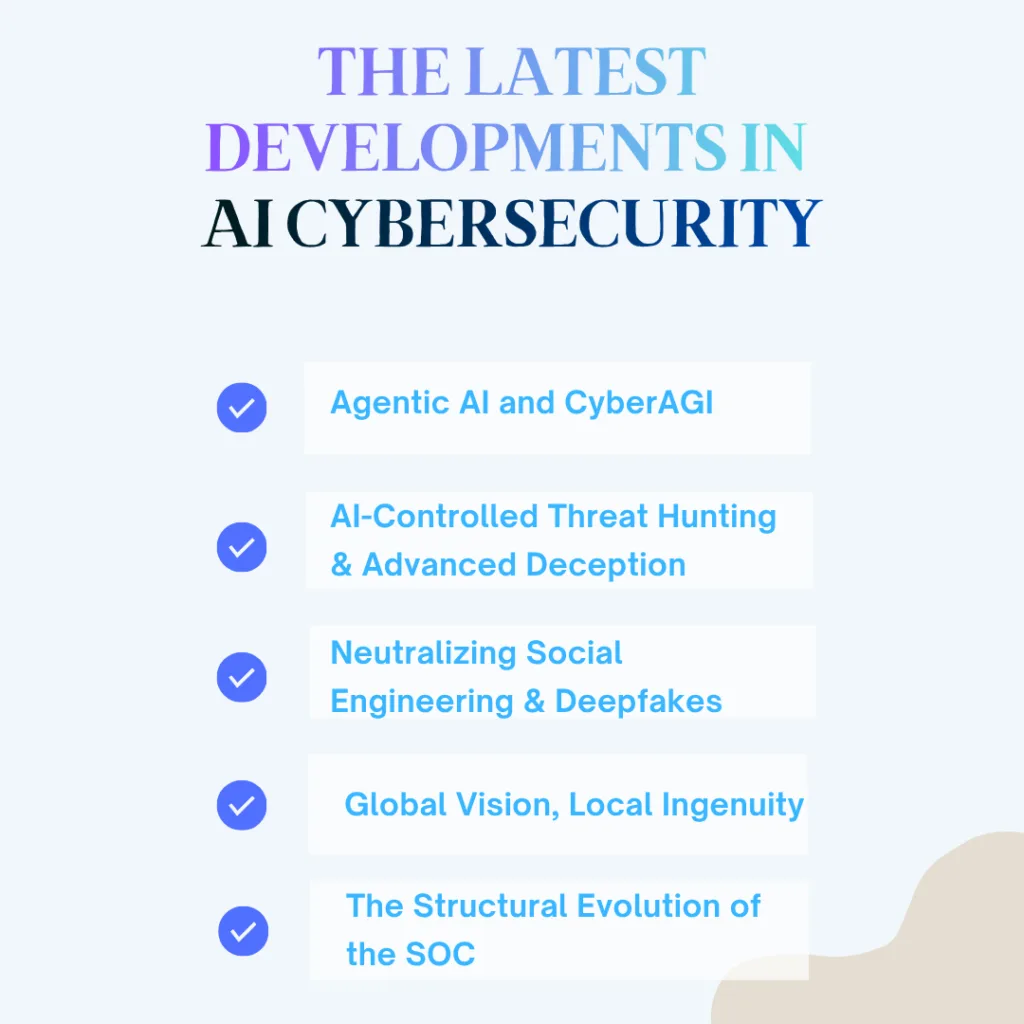
The landscape of threat management is undergoing a structural evolution. In 2026, defense mechanisms are pivoting away from human-dependent triage toward autonomous, self-healing frameworks.
1. Agentic AI and CyberAGI
By far the most disruptive paradigm shift is the transition to Agentic AI—systems designed with autonomous agency that act decisively without waiting for human prompts.
- Beyond Analytics: Legacy security tools merely flag issues for human review.
- Autonomous Defenders: Next-generation frameworks independently execute vulnerability patching, deploy localized firewalls, and neutralize complex threats in real time.
2. AI-Controlled Threat Hunting & Advanced Deception
Modern cyber criminals actively weaponize adversarial machine learning to slip past firewalls undetected. To shift the tactical advantage back to defenders, security architectures are integrating automated deception models:
- Dynamic Emulation: Rather than relying on static, predictable networks, AI-backed deception platforms spin up highly complex, synthetic “honeypots.”
- Isolate & Observe: These environments mimic real production servers to attract, confuse, and analyze attackers in a sandbox, extracting threat signatures without risking corporate assets.
3. Neutralizing Social Engineering & Deepfakes
Generative AI has hyper-personalized social engineering, turning phishing into a highly targeted, multi-channel threat vector.
- The Threats: Criminals utilize advanced voice cloning and deepfake video synthesis to generate “Phantom CEO” email directives, fraudulent wire transfer requests, and synthetic board-member calls.
- The Countermeasures: Modern defensive systems employ localized, multi-modal detection layers. By constantly analyzing micro-expressions, speech frequencies, and metadata, enterprise platforms intercept malicious media before it targets employees.
4. Global Vision, Local Ingenuity
The geopolitical nature of cyber risks requires localized specializations that scale globally. Startups are building focused tools engineered for specific threat environments:
| Regional Innovation Hub | Operational Specialty | Strategic Focus |
| United States (e.g., Nebulock) | Autonomous Threat-Hunting | Eradicating “low and slow” network lateral movement within large enterprise fabrics. |
| India (e.g., Vastav AI / TraceX) | Synthetic Media Forensics | Combating deepfake-led financial fraud and regional political disinformation campaigns. |
5. The Structural Evolution of the SOC
Artificial intelligence is fundamentally transforming the traditional Security Operations Center (SOC) from a reactive, high-burnout environment into a streamlined, proactive hub.
The Hybrid SOC Shift: Security analysts no longer spend tedious hours scanning endless, monotonous log files. Instead, AI copilots handle autonomous intake, false-positive filtering, and low-level alert triage. This frees human operators to focus entirely on high-level architecture, threat modeling, and defensive engineering.
The Importance of These Startups
- Counteracting Emerging AI Assaults: The only solution to face the new emerging challenges of AI-generated ransomware and malware is provided by startups.
- Fighting the New Surge of Cybercrime in India and Other Countries: As the prime target of Artificial intelligence driven phishing and ransomware attacks, India fuels the need for more homegrown solutions.
- Motivating Human Cyber Defense Teams: AI-driven cyber security platforms facilitate automation of monotonous and time demanding functions, allowing security professionals to fully devote their efforts to strategy and creative processes.
Related Blog – Cybersecurity Measures for Protecting Business Data Online: A Comprehensive Guide
How Arunangshu das Can Help: Nurturing Innovation in AI Cybersecurity
The tech blog Arunangshu das, put together by AI and software wizard Arunangshu Das, is an excellent space for early-stage cybersecurity startups to penetrate a particular demographic segment of developers, tech decision-makers, SaaS enthusiasts and startup leaders.
Promotional Opportunities
For startups, and other brands, this may mean partnership through sponsored posts, guest blogs or thought leadership pieces that feature their unique uses, benefits of the product and founder story.
Targeted Content Formats
From listicles like Top AI Cybersecurity Startups to Watch to deep case studies and technical explainers, Arunangshu das has multiple storytelling formats, all designed to play up a startup’s best assets.

High-Impact Digital Exposure
With an array of features including banner ads, placement in the newsletter, and in-article promotion, startups can now reach a worldwide audience of readers interested in AI and cybersecurity technology directly.
In short: Arunangshu Das not only covers the world of technology but it also acts as a gateway for the startups to introduce them and promote them to its audience.
Read more blogs : How AI Agents Work and How Developers Can Build One from Scratch
Final Thoughts
These are the AI cybersecurity startups in 2026 rewriting the rules of how businesses predict and thwart cyber attacks. These companies are not simply reacting to cybercrime, they are helping to define the future of digital trust and resilience, with their products doing everything from automating malicious behavior to detecting deepfakes.
So, for these pioneers, platforms, such as Arunangshu Das offer important platforms for getting their solutions in front of the correct audience — developers, cybersecurity practitioners, and startup investors. At a time when digital security is more important than ever, this visibility fast-tracks not just the growth for the startups, but the worldwide mission to take on cyber crime.
Frequently Ask Question:
What is “Agentic AI” and how does it differ from traditional AI security tools?
Traditional AI security tools act as assistants—they scan logs, detect anomalies, and generate alerts that require a human analyst to review and fix. Agentic AI systems possess autonomous agency. Once given a high-level goal (e.g., “secure this network segment”), they can independently evaluate a live threat, choose the correct tools, and execute defensive actions—such as deploying patches or isolating infected servers—without waiting for human authorization.
What is CTEM, and why is Safe Security’s approach considered groundbreaking?
CTEM stands for Continuous Threat Exposure Management. It is a five-stage framework (Scoping, Discovery, Prioritization, Validation, Mobilization) designed to constantly scan an organization’s attack surface. While traditional CTEM platforms merely score and rank risks, Safe Security’s CyberAGI platform is groundbreaking because it automates the final step: it leverages agentic AI to actively patch vulnerabilities and resolve exposures in real time before hackers can exploit them.
How does behavioral threat-hunting catch “low and slow” cyberattacks?
Legacy security systems look for known “signatures” (like a blocklist of recognized malware code). Modern attackers bypass this by using unique, AI-generated code and executing attacks “low and slow”—such as stealing tiny, unnoticeable fragments of data over months. Behavioral threat-hunting (pioneered by startups like Nebulock) continuously tracks anomalous activity patterns across an entire network. If a server or device begins behaving strangely—even if no malware is detected—the AI flags the correlation and halts the lateral movement.
Will AI security copilots completely replace human analysts in the SOC?
No. Instead, they are redefining the architecture of the Security Operations Center (SOC) into a hybrid environment. AI copilots excel at handling data-heavy, high-volume tasks that typically cause human burnout—such as raw log ingestion, initial artifact triage, and false-positive filtering. This vertical shift clears the cognitive backlog, allowing human analysts to move away from tedious screen-watching and focus entirely on high-level strategy, threat modeling, and complex incident response.
